Development · 2026
MyTCG
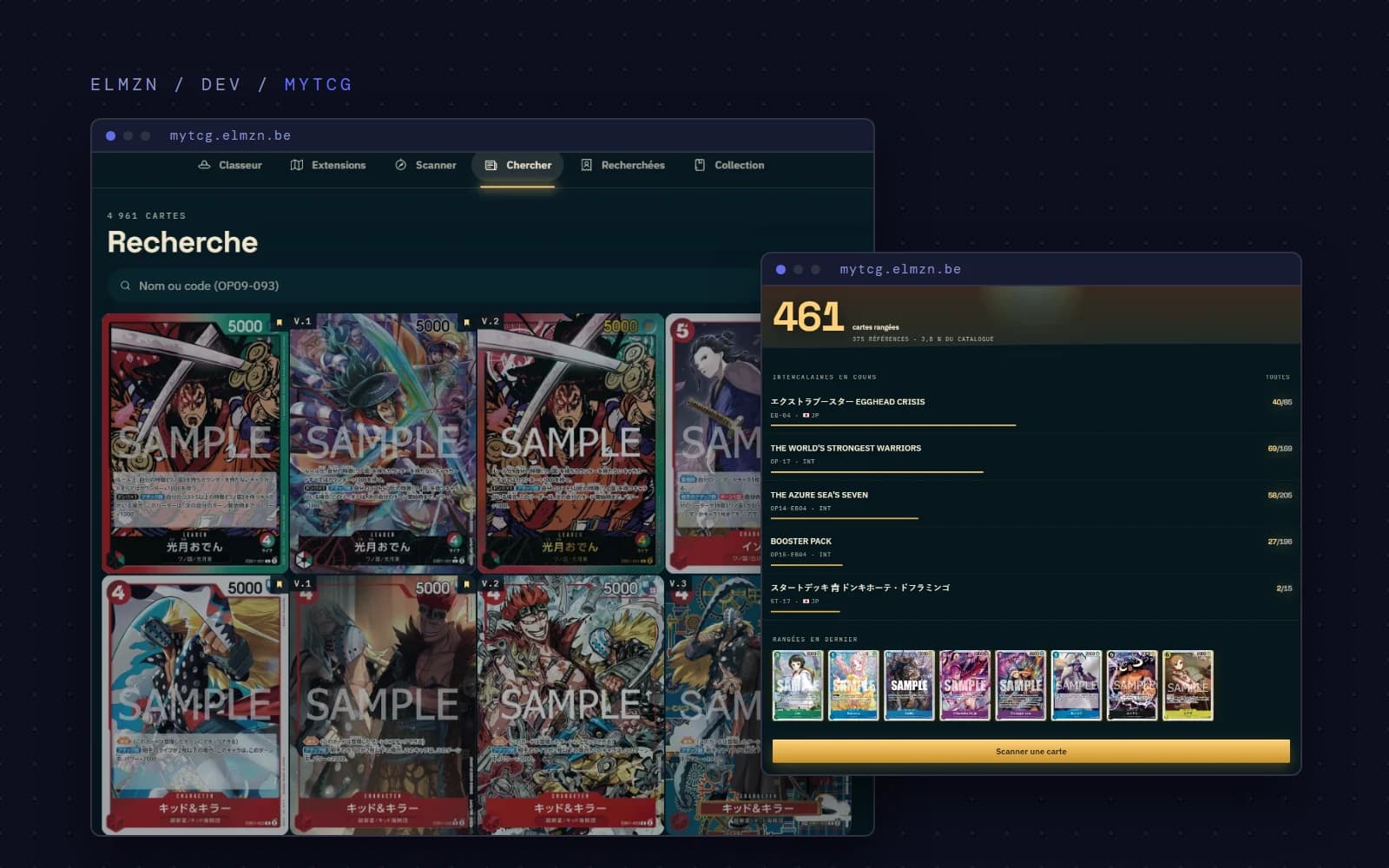
My One Piece card collection on my phone: I point the camera at a card, the app recognises it, in its English or Japanese edition, and tracks its price.
Spec sheet
- Year
- 2026
- Role
- Design and development
- Stack
- React
- TypeScript
- FastAPI
- SQLite
- Capacitor
Context
Collecting One Piece cards means following hundreds of references, in two languages, and their moving prices. MyTCG keeps my collection and recognises a card through the camera. It runs on my homelab.
Choices
- Recognise the artwork, not the text. Every card in the official catalogue is reduced to a fingerprint of its artwork (a perceptual hash); a photo is compared with all of them. The text changes from one edition to the other: I pick the language, the app does not guess it.
- Never wrong in silence. On 24 photos of real cards — in a binder, with glare, at an angle — 75% are recognised and not one wrong answer is shown: right and wrong matches never overlap, a threshold separates them. What fails goes to manual search.
- The camera stays on. Like a barcode scanner: the app only sends a frame once it is steady, and freezes on the card it found.
- Two editions, two prices. The English and Japanese catalogues, and their prices in euros.
What got stuck
- The "SAMPLE" watermark on every official image, absent from real cards: it had to be located, and the fingerprint framed above it.
- Reprints with identical artwork: no fingerprint can tell them apart, so the app offers the choice.
- A 64-bit fingerprint that does not fit in a SQLite signed integer without losing its last bits.